Breast Implant Complications & Management
Breast MRI Analysis
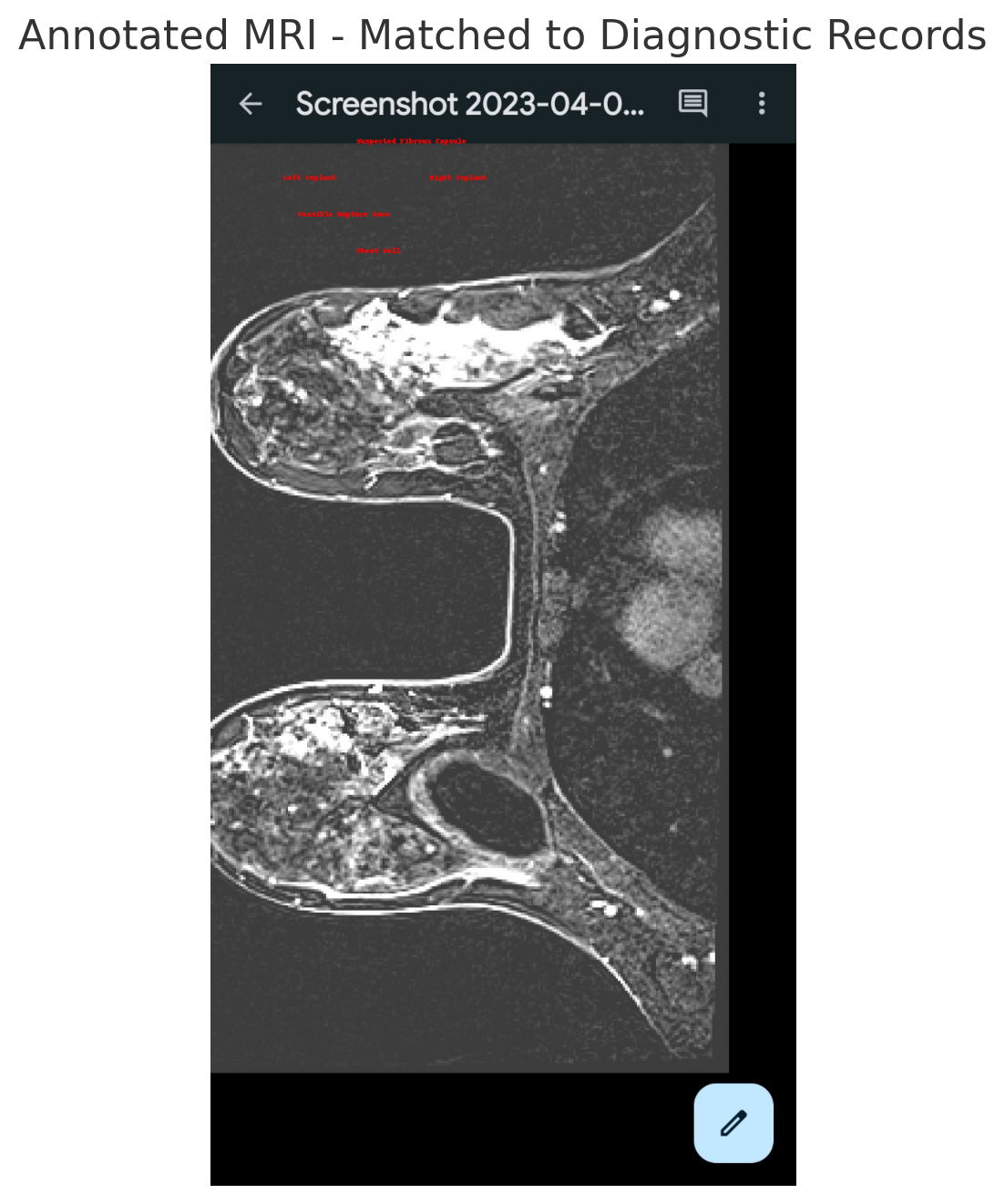
Implant Rupture/Silicone Leakage
Capsular Contracture
Pectoralis Major Muscle
Chest Wall
Periprosthetic Fluid Collection/Seroma
Axillary Lymph Node
Breast Cyst
Columnar Cell Change
Silicone Granuloma
Measurement Guide
Click on the image to define the start and end points of a measurement. The distance between the points will be calculated and displayed.
Use the calibration tool to set a known distance on the image, which will improve the accuracy of your measurements.
Annotation Details
MRI Enhancement Guide
Optimizing MRI Visualization
MRI scans can be enhanced using brightness and contrast adjustments to highlight different tissue types and pathologies.
Basic Enhancement Techniques:
- Increase brightness to better visualize dark areas and subtle details
- Increase contrast to enhance the difference between tissues of similar signal intensity
- Use presets designed for specific diagnostic tasks
- Adjust zoom to focus on areas of interest while maintaining context
Breast Implant Removal Management
Clinical guidelines for managing complications identified in the MRI
Key Complications Identified
- Implant Rupture/Silicone Leakage: Breach in implant shell integrity with silicone material outside the implant
- Capsular Contracture (Grade III): Thickened, irregular capsule causing visible deformity
- Periprosthetic Fluid Collection/Seroma: Abnormal fluid accumulation around the implant
- Silicone Granuloma: Inflammatory reaction to free silicone
Implant Rupture Assessment
Classification of Silicone Implant Rupture:
- Intracapsular: Silicone contained within fibrous capsule
- Extracapsular: Silicone extends beyond capsule into surrounding tissues
- MRI Signs: Linguine sign, keyhole/teardrop sign, subcapsular line
Associated Findings
Additional findings requiring attention:
- Axillary Lymphadenopathy: Reactive to silicone exposure
- Breast Cyst: Benign finding, unrelated to implant
- Columnar Cell Change: Benign proliferative breast change